Usage: The Aerodynamics Lab
Speed Through Weight Reduction
Section titled “Speed Through Weight Reduction”(Professor Solo stands in a wind tunnel, shouting over the roar of a massive turbine. He’s wearing a lab coat that looks suspiciously like a racing suit.)
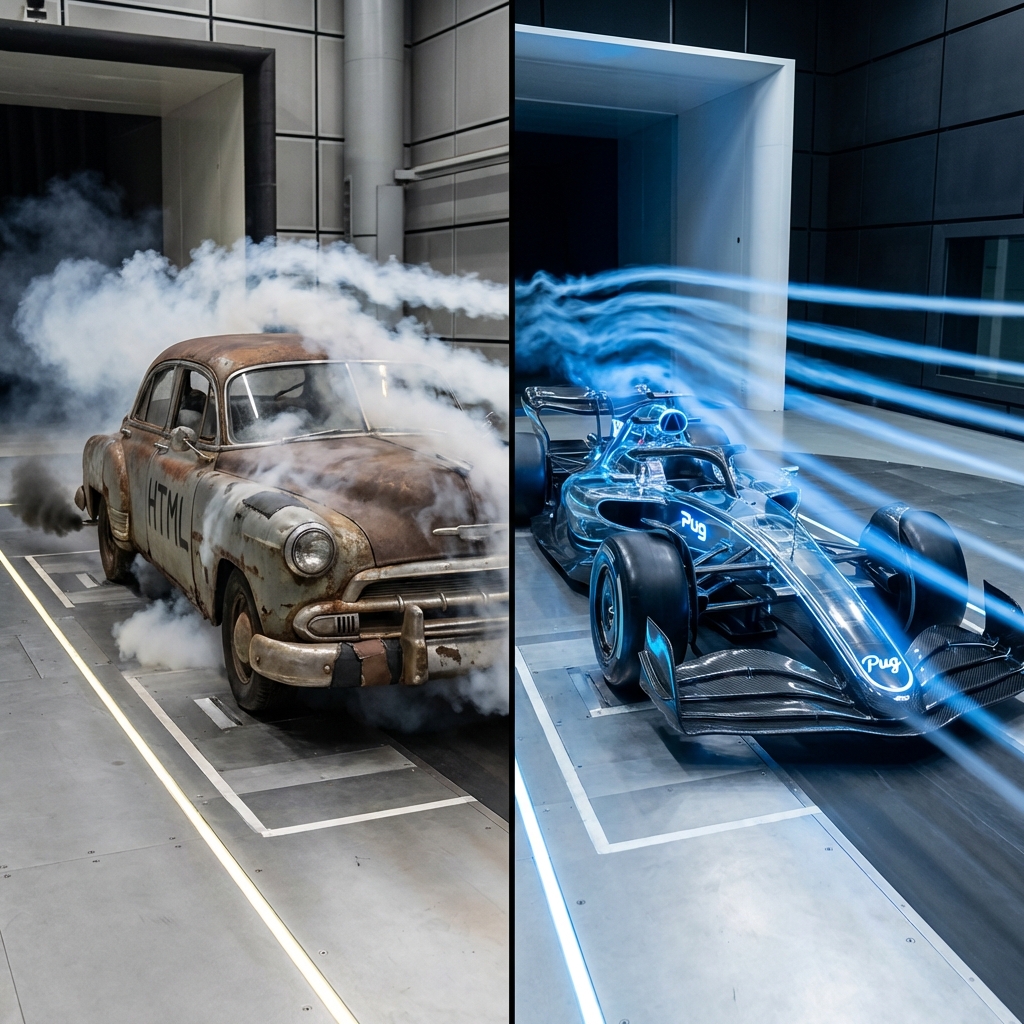
Welcome to the Aerodynamics Lab, cadets! Until now, you’ve been driving the heavy haulers of the web—standard HTML and EJS. They’re reliable, sure, but they’re built like tanks. Heavy closing tags, bracket-bolted syntax, and angle-bracket drag coefficients that would make a race engineer weep.
Today, we strip the chassis. We’re upgrading to Pug (formerly Jade), the carbon-fiber monocoque of view engines. We are removing the steel panels (closing tags) and the heavy bolts (angle brackets) to rely purely on aerodynamic flow (indentation). If it doesn’t make the car go faster, it doesn’t get bolted on.
The Weight Difference
Section titled “The Weight Difference”Sent to the lab by lead engineer Linus Pug-valds, this engine is designed for one thing: Developer Velocity.
[!NOTE] T.A. Watts says: Don’t get too comfortable with the “it just works” vibe. In this lab, whitespace is structural. If you drift your indentation by a single millimeter (space), you hit the wall. Precision isn’t optional; it’s physics.
Why We Race With Pug
Section titled “Why We Race With Pug”- Reduced Drag: No closing tags means less keystrokes. Less keystrokes means faster features.
- Structural Integrity: The indentation forces you to write clean, nested code. You can’t write messy HTML in Pug; the engine simply won’t start.
- High-Octane Logic: Pug has JavaScript baked right into the fuel mix. Loops and conditionals aren’t bolted on; they’re part of the chassis.
⏭ The Pit Crew Setup
Section titled “⏭ The Pit Crew Setup”Enough talk. Let’s get this engine on the dyno and see if it purrs.
Next Lap: Installing the engine and calibrating the intake manifold.