SQL vs. NoSQL
The Mental Shift
Section titled “The Mental Shift”If we’re coming from a SQL background (like MSSQL), we are used to thinking in Grids. We define the columns first, and if data doesn’t fit the grid, it doesn’t get in.
MongoDB asks us to think in Objects.
The Vocabulary Swap
Section titled “The Vocabulary Swap”The concepts are similar, but the containers are different.
| SQL Term | MongoDB Term | The Metaphor |
|---|---|---|
| Table | Collection | The particular bank vault room (e.g., “Users Room”). |
| Row | Document | A single safety deposit box inside that room. |
| Column | Field | An item inside the box. |
| Join | Embedding | Putting the user’s address inside their box instead of a separate room. |
The Structure War
Section titled “The Structure War”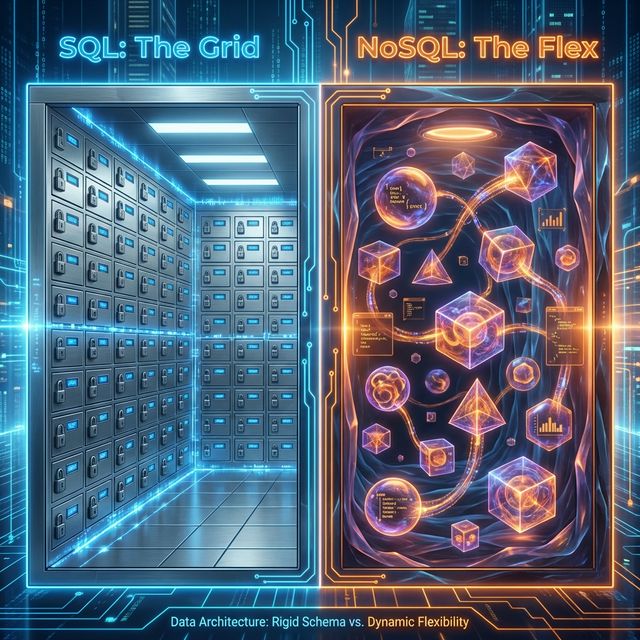
Team SQL: “The Enforcer”
Section titled “Team SQL: “The Enforcer””In a SQL database, the schema is the law.
- Pros: strict data integrity, efficient for complex relationships.
- Cons: “Migration Headaches.” Changing a column means updating the laws of the entire grid.
Team NoSQL: “The Flex”
Section titled “Team NoSQL: “The Flex””In MongoDB, the schema is a suggestion (until we enforce it later).
- Pros: Speed. We can save a User with 3 fields and another with 50 fields in the same collection.
- Cons: “Messy Room Syndrome.” If we aren’t disciplined, our data becomes a swamp.
T.A. Watts says
“NoSQL doesn’t mean ‘No Structure.’ It means ‘Not Only SQL.’ In reality, it means we are responsible for the structure in our application code, rather than blocking the door at the database level.”
Visual Anchor: The JSON Document
Section titled “Visual Anchor: The JSON Document”Unlike a flat row, a MongoDB document is rich. It can possess depth.
// A typical MongoDB Document{ "_id": "507f1f77bcf86cd799439011", "username": "NeonRider", "stats": { "level": 5, "score": 9000 }, // Nested Object (Embedded) "inventory": ["sword", "shield", "potion"] // Array}Try doing that cleanly in a single SQL row.
Extra Bits & Bytes
Section titled “Extra Bits & Bytes”📘 SQL vs NoSQL (PNG)
⏭ Constructing the Facility
Section titled “⏭ Constructing the Facility”Building your own free Atlas Cluster in the cloud.