The RBAC Middleware
The Two-Layer Security Guard
Section titled “The Two-Layer Security Guard”In the previous lesson, we implemented the requireAuth middleware, which explicitly validates incoming session cookies and blocks anonymous access to the admin dashboard.
Role-Based Authorization introduces a “Two-Layer” defensive architecture, seamlessly augmenting our existing security perimeter:
- Authentication Layer: Are you logged into the application? (Handled by
requireAuth). - Authorization Layer: Do your capabilities align with the requested action? (Handled by our new
requireRole).
Constructing requireRole
Section titled “Constructing requireRole”To apply this correctly, we dynamically construct completely reusable, centralized middleware. This generic function accepts an array of allowed roles and fundamentally evaluates the incoming req.user against that array before passing control to the final controller.
// Layer 1: The standard Authentication Guardfunction requireAuth(req, res, next) {  if (req.isAuthenticated?.() && req.user) return next();  return res.redirect("/admin/login");}
// Layer 2: The dynamic Role Authorization Guardfunction requireRole(...allowedRoles) {  return (req, res, next) => {    // Failsafe: If no user context exists, bounce them    if (!req.user) return res.redirect("/admin/login");
    // Evaluate if the user's role string actively matches the allowed array    if (allowedRoles.includes(req.user.role)) {      return next();    }
    // Explicit Authorization Failure    return res      .status(403)      .send("Access Denied: You do not possess the required capabilities.");  };}
module.exports = { requireAuth, requireRole };
Professor Solo: The incredible power of requireRole(...allowedRoles) is
the spread operator. It allows us to dynamically configure the middleware
right at the router level by passing in an array of strings (e.g.
requireRole("ADMIN", "MODERATOR")), creating a modular, reusable security
barrier.
Once this centralized function acts as the gatekeeper, we can secure every administrative endpoint. Checking the role in one centralized place drastically reduces security breaches.
T.A. Watts Note: Checking req.user.role natively inside specific
individual route handlers creates sprawling authorization “spaghetti”.
Consistently prioritize deploying your centralized generic middleware over
every administrative route. It is vastly safer to secure an endpoint centrally
than scattering if(role === 'ADMIN') throughout 50 controllers.
The Security Perimeter
Section titled “The Security Perimeter”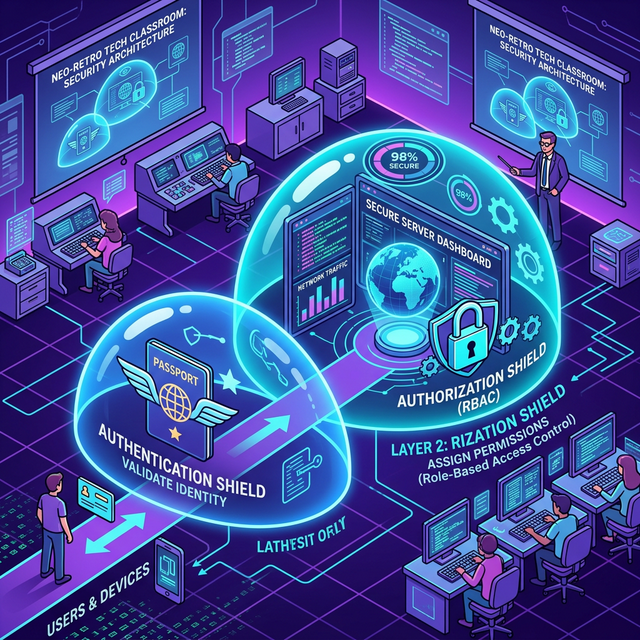
Fig 1: Layer 1 Authentication (Passport) vs. Layer 2 Authorization (RBAC)
⏭ Next: Enforcing Capabilities
Section titled “⏭ Next: Enforcing Capabilities”The bouncers are ready. Let’s tell them which Express router doors to guard.